Business Security Systems UK: 2026 Buyer's Guide


Last updated: 7 September 2026
Quick answer: A security system for a company combines physical measures — CCTV, alarms, access control, manned guarding — with cybersecurity protocols such as firewalls and encryption, to protect assets, staff and data from theft, unauthorised access and cyber threats. Businesses that integrate these layers, rather than buying them piecemeal, typically see fewer theft and vandalism incidents and stronger operational resilience.
Key Takeaways
- A company security system integrates physical protection (CCTV, alarms, access control, manned guarding) with cybersecurity measures (firewalls, encryption, intrusion detection) into one framework.
- Layered protection — surveillance, alarms, access control and cybersecurity working together — reduces the chance that a single point of failure exposes the whole business.
- Hostile vehicle mitigation (HVM) uses physical infrastructure such as bollards and barriers to stop vehicles being used as weapons; it is a specialist but increasingly relevant measure for high-risk sites.
- Priority First, a London-based security and facilities management company, has protected over £1.6 billion in client assets across prime central London and nationwide, holding a 5.0-star Google rating from 44 reviews as of 2024.
- On one recent emergency callout in Covent Garden, Priority First moved from first contact at 12:30 to an SIA-licensed operative on site at 14:30 — a two-hour deployment time.
Overview
This article sets out the essential features and role of security systems for companies, covering their function in safeguarding both physical and digital assets against a range of threats. It explains how integrated security measures — surveillance cameras, alarm systems and cybersecurity protocols — work together to avert financial losses, mitigate liability risks, and support a company's reputation and operational continuity.
Introduction
Business security threats have grown more sophisticated, which makes it essential for companies to understand how modern security systems actually work. These systems combine physical and digital safeguards, designed to protect assets, data and personnel from a range of risks — from break-ins and theft to data breaches. By understanding the critical features and benefits of an effective security system, organisations can strengthen operational integrity and create a safer working environment.
With so many options on the market, how can a company work out which security measures genuinely address its specific vulnerabilities? Ignoring this question can lead to real financial, operational and reputational consequences — a break-in, a data breach, or an uninsured loss can all be traced back to gaps in a poorly planned security setup.
Understanding the landscape of business security is therefore not a box-ticking exercise. It is a strategic decision that directly affects business resilience.
What Is a Security System for a Company?
A security system for a company is an integrated set of measures and technologies that protects physical and digital assets against unauthorised access, theft, vandalism and other operational risks. It typically combines physical protection elements — surveillance cameras, alarm systems and access control mechanisms — with cybersecurity measures such as firewalls, encryption and intrusion detection systems. Together, these elements create a single protection framework that secures employees and customers while reinforcing the operational integrity of the business as a whole.
Companies that adopt a joined-up approach to security — rather than buying CCTV, alarms and cyber tools separately from different suppliers — are generally better placed to spot and close gaps between systems, since a single accountable provider is more likely to notice where physical and digital protection overlap or fail to communicate. Real-world examples include corporate offices that combine advanced surveillance technologies with cybersecurity protocols, giving them a coordinated defence against both physical intrusion and digital compromise. Retailers face a related but distinct set of challenges around stock loss and public-facing premises, covered separately in our retail security systems guide.
The UK government's Cyber Security Breaches Survey illustrates why integrated protection frameworks matter for corporate environments: as businesses face increasingly sophisticated risks spanning both the physical and digital domains, a cohesive protection strategy — rather than a patchwork of disconnected tools — is what actually closes the vulnerabilities attackers look for.
Why Do Security Systems Matter for Business Operations?
Security systems matter because they are a company's first line of defence against theft, fraud, liability claims and reputational damage — protecting not just physical assets but also sensitive data and intellectual property. A well-executed security system can prevent financial losses from theft or fraud, reduce liability risks, and help a business meet its own compliance and insurance obligations. For companies managing premises with high footfall or high-value contents, this is not optional infrastructure — it is a core part of running the site.
A well-executed protection system typically delivers three things for a business:
- Prevention of financial losses from theft or fraud
- Reduced liability risk
- Support for compliance with relevant industry and insurance standards
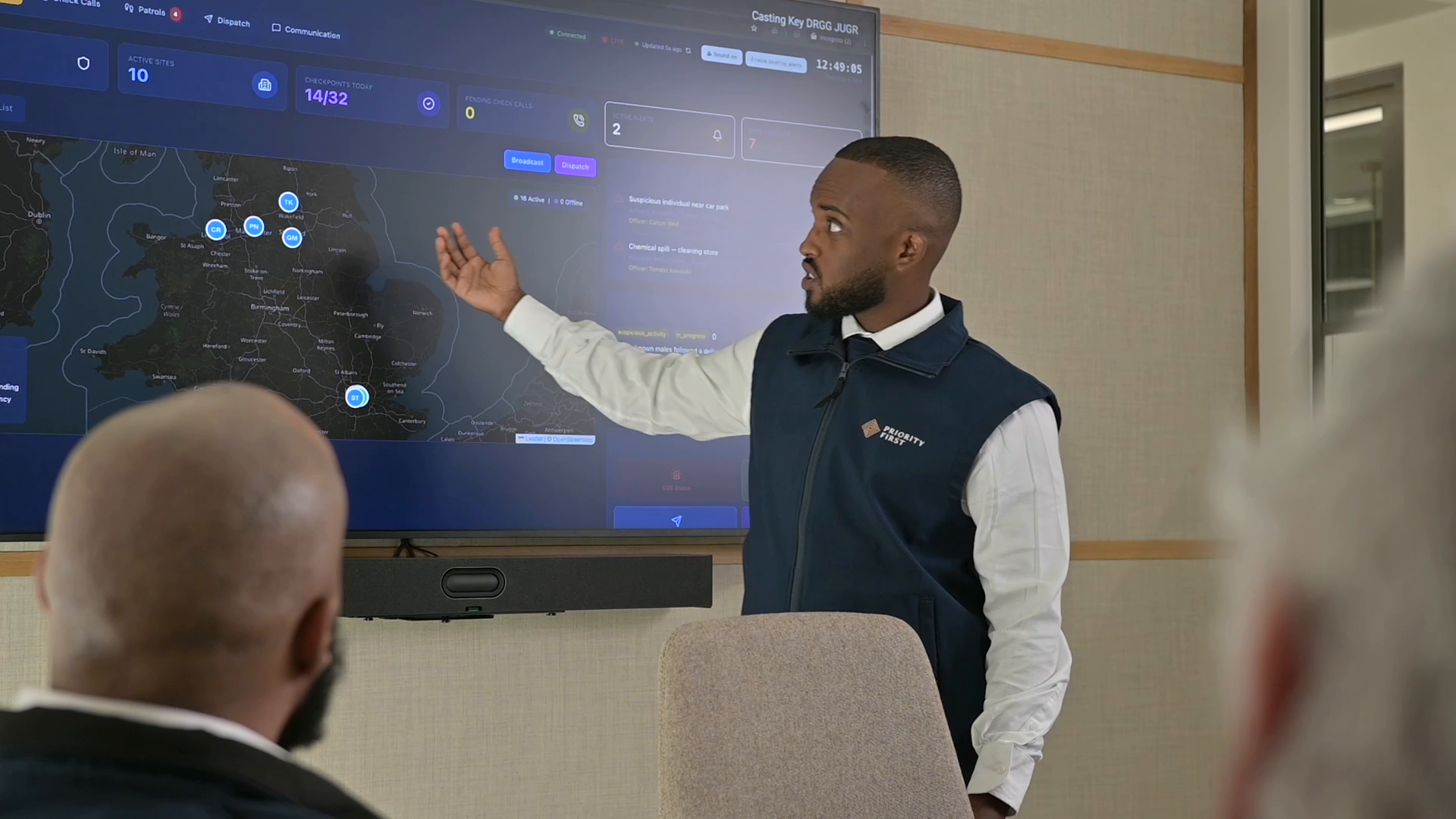
Priority First's own operational data illustrates what a well-run security system looks like in practice. Across its largest managed portfolio, Priority First now runs 24 sites on a single monitoring platform, up from 18, with over 4,900 photo-backed patrols completed — each one carrying officer ID, GPS location and a timestamp. On one mixed-use development alone, Priority First took checkpoint photography from zero before onboarding to 152 photographed checkpoints, with 100% of checkpoint completions now carrying a watermarked photo. That level of verifiable evidence is the difference between a security system that looks robust on paper and one that can actually prove what happened on any given night.
Businesses that invest properly in security systems typically report fewer incidents of workplace violence and theft, which supports a safer environment for employees and clients alike. A visible, well-run security presence can also strengthen client and stakeholder trust — particularly for facilities managers and landlords who need to demonstrate due diligence to tenants, insurers or investors.

What Are the Key Features of an Effective Security System?
An effective security system is built from several features that work together rather than in isolation: surveillance, alarms, access control, cybersecurity, and integration between all of them. High-resolution CCTV cameras with night vision and motion detection monitor premises and deter criminal activity, while intruder alarms trigger alerts on unauthorised access, and access control systems — key cards, fobs or biometric scanners — restrict entry to specific areas. None of these features works as well on its own as it does combined with the others.
Surveillance capability is a foundation layer: cameras with night vision and motion detection do the passive work of monitoring and deterrence, but their real value comes from being backed by active 24/7 CCTV monitoring, so that footage triggers a swift human response rather than simply being reviewed after the fact.
Alarm systems add a second layer, with intruder alarms designed to trigger immediate alerts on unauthorised access. Access control systems then regulate who can enter specific areas of a building, commonly using key cards or biometric scanners to prevent unauthorised entry — an area covered in more depth in our guide to concierge versus porter-led access control for corporate buildings.
Cybersecurity measures are equally essential in a digital-first business environment. Firewalls, antivirus software and data encryption protect digital assets from cyber threats and safeguard sensitive information — the Private Security Industry Act 2001 and related SIA (Security Industry Authority) licensing requirements govern the physical security workforce, but data protection sits under separate legislation and should be planned for alongside physical security, not as an afterthought.
Integration and automation tie these layers together, allowing a single incident — a forced door, an unrecognised vehicle, an out-of-hours alarm trigger — to set off a coordinated response, such as locking doors or notifying on-site personnel automatically. A provider running both the physical security and the wider building operation, as Priority First does through combined manned guarding and facilities management, is better placed to integrate these elements without disruption, since the same team manages the cameras, the access control and the guarding rota.
Hostile vehicle mitigation (HVM) — physical infrastructure such as bollards and barriers designed to stop vehicles being used as weapons — is a more specialist feature, but an increasingly relevant one for sites with public access, events, or high footfall. Regular maintenance and review of all these systems is essential: a camera with a dead battery or an access control system running outdated firmware creates exactly the kind of silent gap that a proper planned preventative maintenance schedule is designed to catch before it becomes a security failure.
By combining these features into a single, tailored plan, companies can build a layered approach to security that meaningfully strengthens both safety and operational resilience — rather than relying on isolated tools that don't talk to each other.
Your Business Security System Checklist
Use this checklist as a starting point when reviewing or commissioning a security system for your company:
- Map your physical vulnerabilities — entry points, loading bays, out-of-hours access, high-value areas
- Confirm CCTV coverage includes night vision and motion detection, backed by active monitoring rather than passive recording
- Check intruder alarms are linked to a monitored response, not just a local siren
- Verify access control (key cards, fobs or biometric scanners) is applied consistently to all sensitive areas, not just the main entrance
- Confirm any manned guarding staff are individually SIA-licensed, as required by the Private Security Industry Act 2001
- Ask whether patrols and checkpoints are evidenced (photo, GPS, timestamp) or simply logged on trust
- Review firewalls, encryption and data protection measures alongside — not separately from — physical security
- Schedule regular reviews and maintenance so the system evolves as threats and premises change
Conclusion
Security systems are essential for companies, safeguarding physical and digital assets while protecting employees, customers and sensitive data. By integrating protective measures — surveillance technologies, alarms, access control and cybersecurity protocols — businesses can build a framework that mitigates risk and strengthens operational integrity.
Comprehensive, well-run security systems can meaningfully reduce incidents of theft and vandalism, supporting a safer workplace environment. Features like continuous monitoring, layered access control, and integrated cybersecurity measures work together as a single strategy rather than a set of disconnected tools.
The value of a security system goes beyond protection alone: it builds trust with clients and stakeholders and supports compliance with relevant standards. As businesses face increasingly sophisticated threats, adopting a well-integrated security strategy is a genuine investment in operational resilience and reputation — not just a cost. Companies should assess their specific security needs and implement tailored solutions that protect assets while supporting day-to-day productivity and peace of mind.
How Priority First Delivers Business Security in Practice
Choosing the right combination of CCTV, alarms, access control and manned guarding is only half the challenge — making sure it is actually delivered, patrolled and evidenced night after night is the other half. Priority First is a London-based security and facilities management company, headquartered in Mayfair (Companies House 14830917), that combines SIA-licensed manned guarding, CCTV monitoring, key holding and alarm response, and construction site security with full facilities and building management under one accountable provider, serving prime central London — including Chelsea, Knightsbridge and Mayfair — West London, and contracts extending into the West Midlands and Bedfordshire.
The difference this makes in practice is measurable: across one 16-building prime London estate, Priority First now delivers 250–280 photo-backed patrols per building, evidence that was previously unprovable under the client's old arrangement. Every checkpoint on that estate requires a photo to complete, so a missed patrol shows up as a visible gap in the record rather than passing silently — the kind of accountability that a security system review, like the checklist above, should be looking for from any provider. Companies weighing up providers more broadly may also find our best security companies London guide useful for comparing what "integrated" actually means in practice.
If your business is reviewing its current security setup, or has never had one properly audited, get in touch with Priority First for a quote and find out what a fully evidenced, integrated security system looks like for your premises.
Frequently Asked Questions
What are security systems for companies? Security systems for companies are a combination of measures and technologies designed to protect physical and digital assets from unauthorised access, theft, vandalism and other risks. They typically include physical protection elements — such as surveillance cameras and alarm systems — alongside cybersecurity measures such as firewalls and encryption.
How do security systems integrate physical and cybersecurity measures? Security systems integrate physical protection elements, such as access control mechanisms and surveillance technologies, with cybersecurity measures like intrusion detection systems and encryption. This integration creates a single protection framework that safeguards employees, customers and sensitive data, rather than treating physical and digital security as separate problems.
What are the benefits of implementing security systems for companies? The main benefits are fewer theft and vandalism incidents, reduced liability exposure, and stronger operational integrity. Combining physical and cybersecurity measures also closes the gaps that appear when different systems are bought and managed separately.
Can you provide examples of security systems in action? Yes — corporate offices commonly combine advanced CCTV and monitoring technologies with cybersecurity protocols as part of one system. On a larger scale, Priority First's own portfolio includes over 4,900 photo-backed patrols across 24 sites on a single platform, each one recording officer ID, GPS location and a timestamp as proof the patrol took place.
Why is an integrated protection framework important for businesses? An integrated framework matters because it closes the vulnerabilities that appear when physical security and cybersecurity are managed as separate, disconnected efforts. As businesses face increasingly sophisticated risks, according to the UK government's Cyber Security Breaches Survey, a single cohesive strategy is what actually reduces exposure — not just having more individual tools in place.